

Ten men
June 5 to 14 2027
Application only
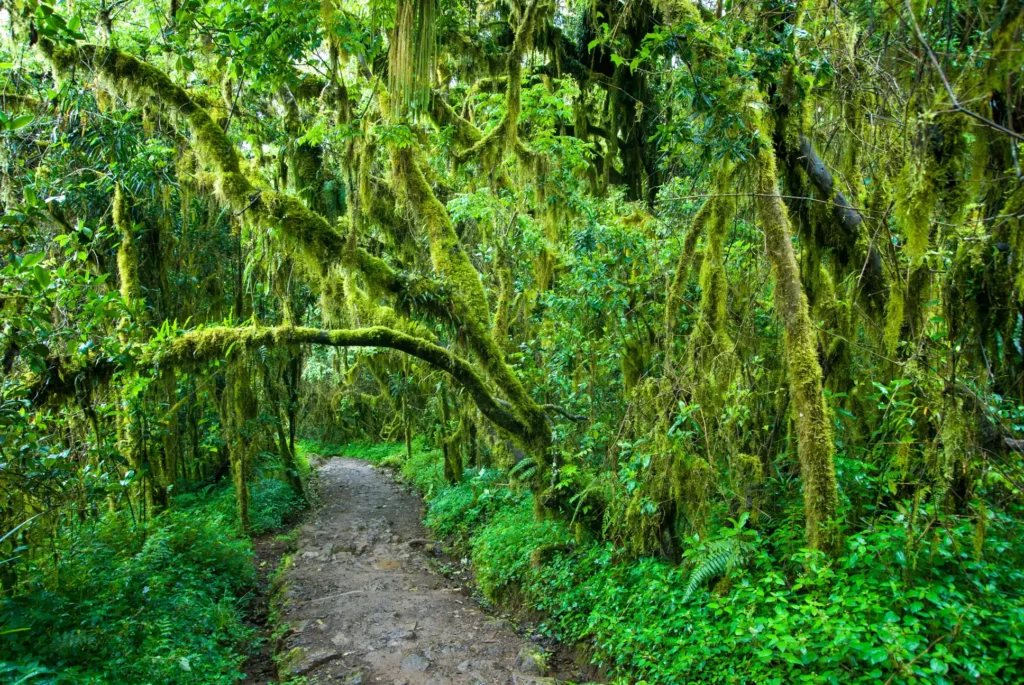
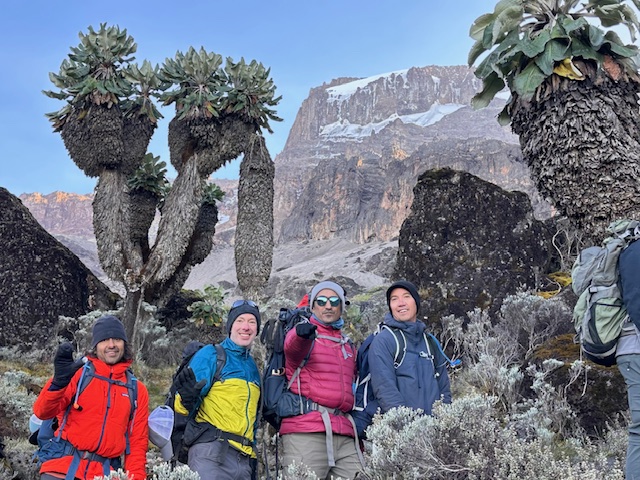
Colobus monkeys overhead. Mist in the canopy. The mountain is up there somewhere, but for two days the forest doesn’t let you see it. You just climb through green light and breathe.
The Shira Plateau — a high-desert caldera the size of a city, crossed by almost no one. Kili floats on the horizon, close enough now to study, far enough to respect. At night the Milky Way comes down to the horizon in every direction. There is no light out here but yours.
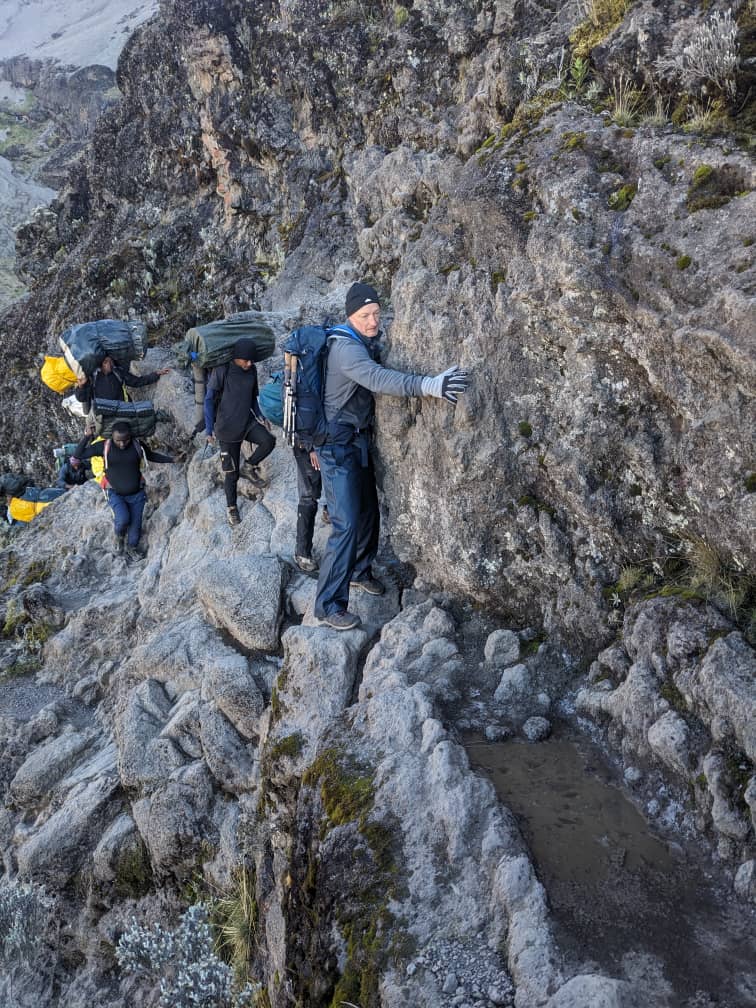
The Barranco wall towers 1,000 feet above our camp. It looks impossible at breakfast. By mid-morning you’re on it, hands on warm rock, moving. By the top you understand something about walls.
Good career. Good family. You handle what needs handling. Anyone looking from the outside would say you’re winning, and they wouldn’t be wrong.
Out there, the noise stops. The overthinking goes quiet. You’re decisive, patient, present. You laugh more in five days on a trail than in five months at home. And somewhere in an ordinary week, a question surfaces at odd moments: is this really it?
Nothing is wrong with you. And nothing is missing from your life. Something is buried in it. The mountain is where you’ve always gone to find him.
This trip is where you learn to keep him.
It’s almost never summit day.
I’ve spent close to three decades guiding expeditions, from Alaska to the Andes to the Himalaya, and I’ve made a study of why trips fail. Then I combined what I learned as a guide with fifteen years as a results coach and a Professor of Student Success, and I mapped the whole journey. Everyone trains for summit day. But this dream dies at four distinct cruxes, and only one of them is on the mountain. This expedition is engineered around all four.
Where the dream dies quietly, before anything ever gets booked.
Here’s a hard truth. For every man who climbs Kilimanjaro, there are dozens who’ve wanted it for years and never will.
Not because of fitness, or money, or the mountain. Because of a conversation with work that never gets had, and a guilt about leaving the family for two weeks that never gets said out loud, it just quietly wins. Solvable concerns, every one. But left alone, they usually win, and the mountain stays a screensaver for another year. And another.
We solve them together, so they don’t cost you the mountain.
What if there was a way to talk to your boss and your coworkers that gets them invested in this trip, rooting for your summit instead of resenting your absence? What if this climb finally inspires the boundaries you’ve been meaning to set and haven’t? What if the way you leave for this mountain creates a more life-affirming relationship with work, with better flow between your work and your life, long after you’re back? And best of all, how you share your journey brings you closer to those you love?
I’ve seen every one of these happen, many times. And I’ll help you find the solutions that fit you and your specific situation.
On the monthly expedition calls you’ll meet your team: a small group of other men navigating exactly what you’re navigating, the same work conversations, the same family calculus, the same training runway. Watching how another guy handled his ask, hearing what worked, pushing each other through the months of preparation. By the time you land in Tanzania, these aren’t strangers. You’ve got months of shared miles before the first step on the trail.
Where the fired-up version of you meets your actual calendar.
Kilimanjaro training plans are everywhere, and they all share the same gap: they train your legs and ignore the thing that really calls it quits. Fitness doesn’t fail on this mountain nearly as often as minds do, and that game is won or lost long before you step on the field.
So we train both.
You’ll get my complete Summit Mindset course, unlocked the day you enroll, and the best tools from my years as a high-performance mindset coach: how to carve out the hours without shortchanging work or family. How to stay locked into your training when the initial fire fades. How to arm your mind so summit night is just another test you prepared properly for. Half the mountain will be up there winging it and hoping. Not you.
When done right, the discipline of this phase does something nobody signs up expecting: your whole life starts firing. Sharper at work, more present at home, up before the alarm. Plenty of men tell me the training months were the highlight of the whole experience.
Where the gremlins show up, and otherwise fit men turn around.
Here’s what almost thirty years at altitude has taught me: the men who turn around are almost never the unfit ones. I’ve watched marathoners and elite athletes quit when the game got real, the wind picked up, and the voice in their head got loud, while the guy everyone quietly counted out dug deeper and stood on the summit at sunrise. The difference was never legs. It was preparation of a kind nobody teaches.
And here’s the part nobody tells you about summit day. I’ve watched two men with identical fitness stand on the same summit after completely different climbs. One spent the night before wide awake at 16,000 feet, heart pounding, running every way tomorrow could go wrong, and started the biggest day of his life already depleted. He ground his way up, tense, counting steps, wishing it would end. The other slept. Same mountain, same weather, same hard. But he’d prepared for what his mind would do when it got heavy, so he wasn’t fighting himself and the mountain at once. He worked, he hurt, and he was there for it, present enough to look around at the biggest morning of his life. Both men summited. Only one actually enjoyed getting there. Kilimanjaro is going to be hard. My job is making sure you don’t make it harder than it needs to be, and that you’re present for the parts you’ll want to remember forever.
On this climb, you’ll have something no other team on the mountain has: a world-class mindset coach on the rope with you, all eight days. Afternoons in the circle with ten sharp men, talking the way men almost never get to talk. One question each night at the fire. And on summit night, when every part of your body is screaming turn around, the tools are already installed and I’m right beside you.
The outfit I partner with runs the best itinerary on the mountain, the eight-day profile with Kosovo high camp, and it produces a 95 percent summit rate. I didn’t pick them from a brochure. I guide for them in the Himalaya, so I know exactly how this team runs a mountain from the inside.
My work on this trip covers what no itinerary can: you, at 2am, when the wind picks up and the gremlins get loud.
That’s how we maximize your odds of standing on top and coming down safely.
The post-trip hangover. Every man who’s done a big trip knows it. Nobody talks about it.
You know exactly how this goes, because it’s gone this way every time. You come off the trip fired up, more alive than you’ve felt in months, and the feeling starts dying before you’re even home. Two weeks later the trip is a collection of pictures on your phone, you’re back in the same routines you left, counting down to the next release.
Or it’s worse than that. The dip. That post-trip malaise where everything feels flat, work is impossible to dig back into, the daily-life stuff feels heavier than ever, and all you want is to be back out there. The best experience of your year, followed by the emptiest month of it.
Here’s the truth underneath the hangover: the mountain doesn’t change you. It reveals you. That man on the summit was you, uncovered. The feeling dies because nobody ever taught you how to bring him home, so every trip ends the same way, with the best version of you left on a mountain somewhere.
Not this one. The 30 days after we land are a built part of this expedition, a structured re-entry protocol designed for one thing: transference. What you tap into up there doesn’t stay up there. The clarity, the presence, the aliveness transfer, into your work, your family, an ordinary Tuesday, until it’s not a trip you took. It’s part of who you are.
And here’s why it works: the presence you train for summit night is the same presence you bring home. One skill. Built on the mountain, kept for good.
The summit isn’t the true crux. Monday is. This time, Monday is trained for.
The before and after bracket the mountain deliberately — the coaching arc holds the climb in the middle.
You prepare obsessively so that when the moment comes, you can finally let go.
Kilimanjaro International Airport to Arusha
Land, meet the team, transfer to the hotel in Arusha. Tonight, a full expedition briefing with our head guide, and dinner with ten men you’ll know for the rest of your life. You just don’t know it yet.
Lemosho Gate to Mti Mkubwa, 9,186 ft
A morning drive to the remote western gate, lunch at the trailhead, then three hours up a little-used track through untouched rainforest to Big Tree Camp. From your first steps you’ll see why we chose this route: the standard lines feel like trails. This feels like wilderness. Tonight’s fire: what are you carrying that you never agreed to carry?
Mti Mkubwa to Shira One, 11,480 ft
A full day climbing through the rainforest into giant moorland, cresting a ridge below the Shira Crater. This is the day the forest releases you onto the plateau and you get your first close look at Kili, the summit cone. The Roof of Africa stops being an idea today.
Shira One to Shira Two, 12,795 ft, with an acclimatization climb to 13,123 ft
An open walk east across the Shira Plateau past the Shira Cathedral, with views across the mountain and down to the plains that do not look real. After lunch, we climb higher and sleep lower, the quiet discipline that gets men to summits. Tonight’s fire: the pattern. Not the label you already know. The loop underneath it.
Shira Two to Lava Tower, 15,223 ft, then down to Barranco, 12,795 ft
The critical acclimatization day. A steady seven-hour push to the Lava Tower for a hot lunch at altitude, then a slow descent into the Barranco Valley, the most spectacular campsite on the mountain, beneath the hanging ice of the Breach Wall. Your body learns the height. Your legs learn the pace of summit night.
Barranco to Karanga, 13,300 ft, over the Barranco Wall
The wall rises a thousand feet straight off camp and looks far worse at breakfast than it climbs. Hands on warm rock, short scrambles, big exposure to glaciers overhead, and by the top most men want to do it again. A shorter day into the Karanga Valley to rest and eat.
Karanga to Kosovo Camp, 16,010 ft
A short, slow, deliberate climb past Barafu, where most teams stop, to our private high camp at Kosovo. This is one of the biggest reasons our success rate is what it is: we sleep higher, quieter, and closer to the rim than almost everyone on the mountain. Early dinner. Gear check. Your declaration comes back to you tonight, in your own words. And then the payoff of seven months of preparation: while half this mountain lies awake burning energy on what tomorrow might bring, you sleep. We wake at 11pm.
Kosovo to Uhuru Peak, 19,341 ft, then down to Mweka Camp, 10,170 ft
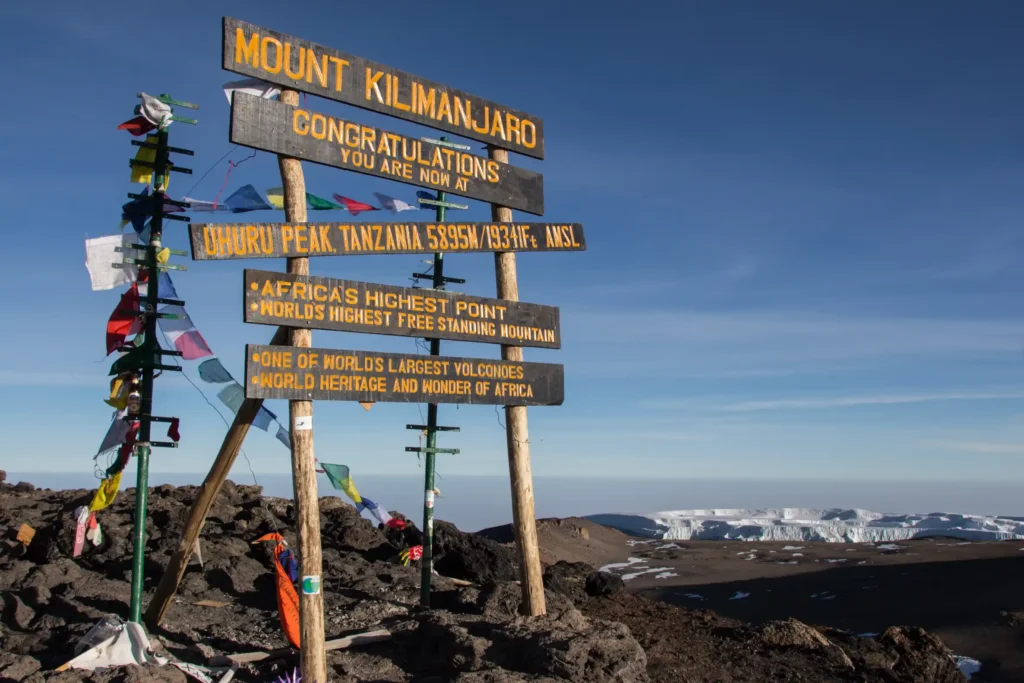
We move at 1am under headlamps and stars, one slow hour at a time, and reach Stella Point on the crater rim as the sun comes up. Then the final hour along the rim, past the glaciers glowing gold on the crater floor, to Uhuru Peak. The summit of Kilimanjaro. Higher than everything, in every direction. The biggest single day of most men’s lives: thirteen hours, a mile of up, nearly two miles of down. The goal isn’t just to endure it. It’s to have enough energy and mental bandwidth left to actually take in what you came all the way to Africa for. You won’t just remember that you made the summit. You’ll remember what it felt like to be fully there for it.
Mweka Camp to Mweka Gate, then Arusha
Three hours down through the rainforest to the gate. We thank the crew that carried this expedition, and by evening you’re showered, fed, and sitting with ten men who know exactly what just happened, because it happened to them too. But the man walking out is not quite the same man who walked in. The integration starts now, as you begin figuring out how to carry what the mountain revealed into the life waiting for you at home.
Arusha to Kilimanjaro International Airport
A rest day and the flight home. This is where every other expedition ends. Ours doesn’t. The re-entry protocol starts the moment you land, because the most important part of this mountain is what happens after it.
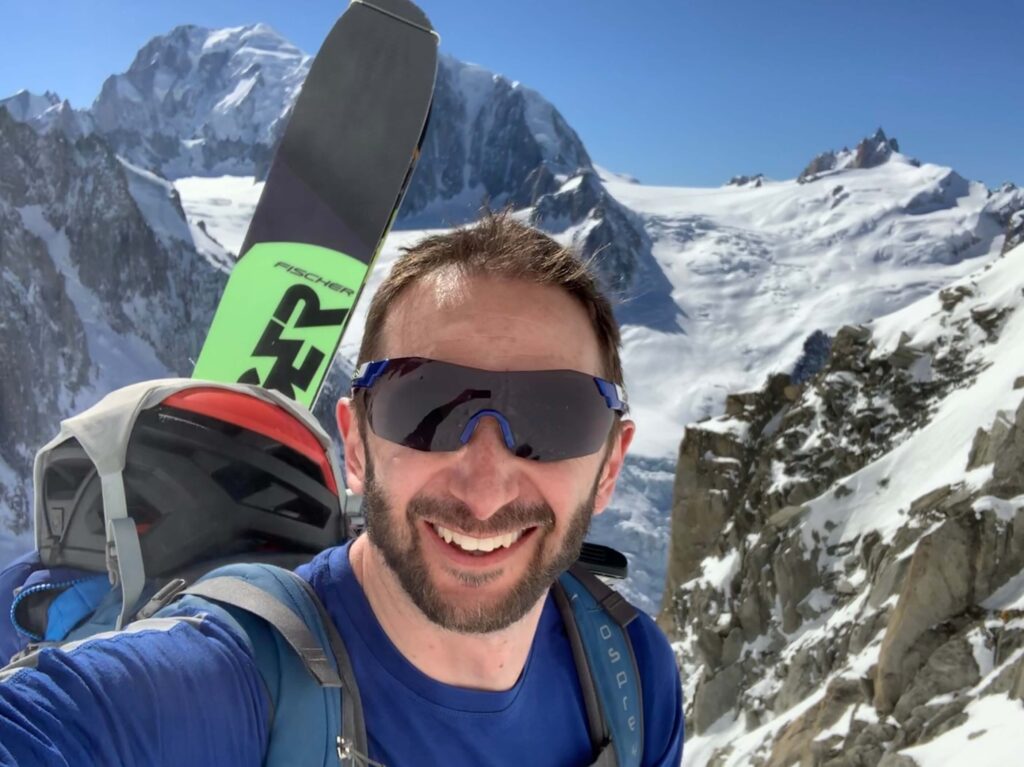
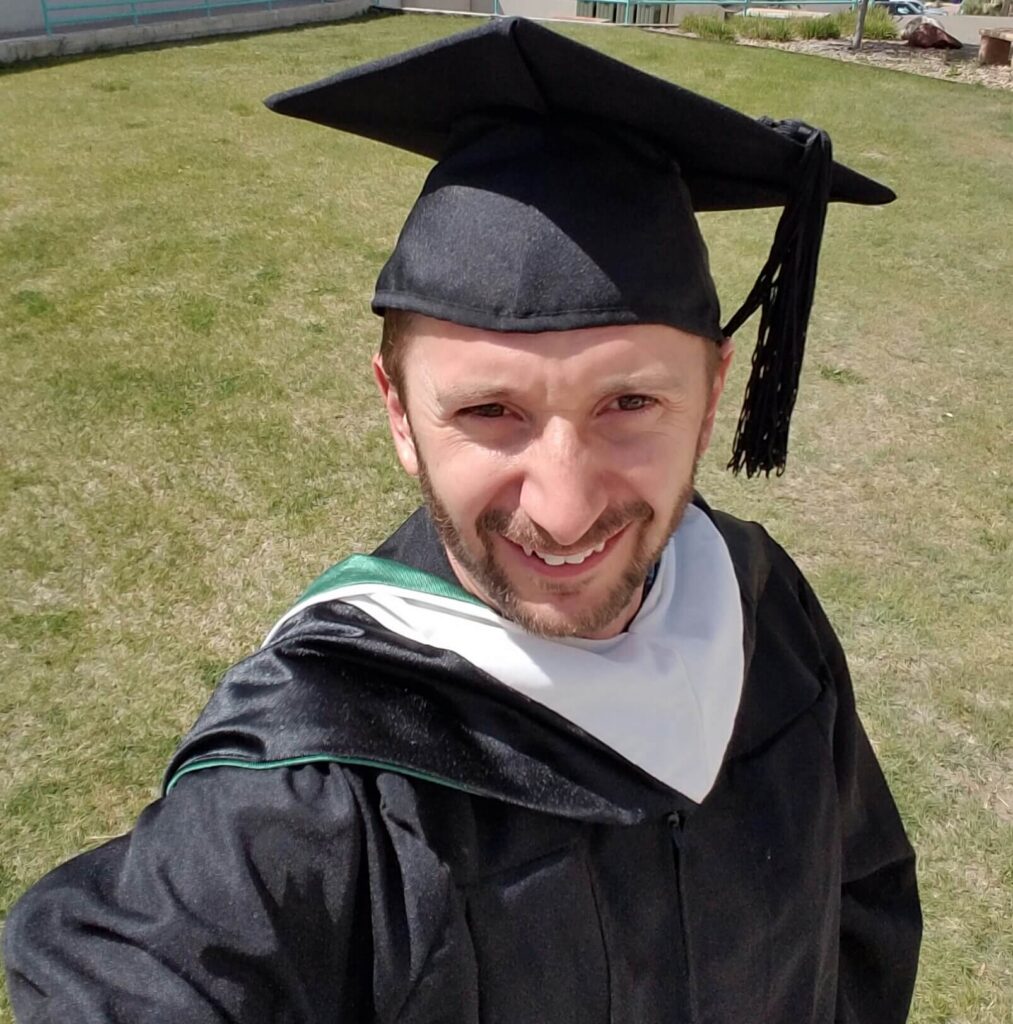
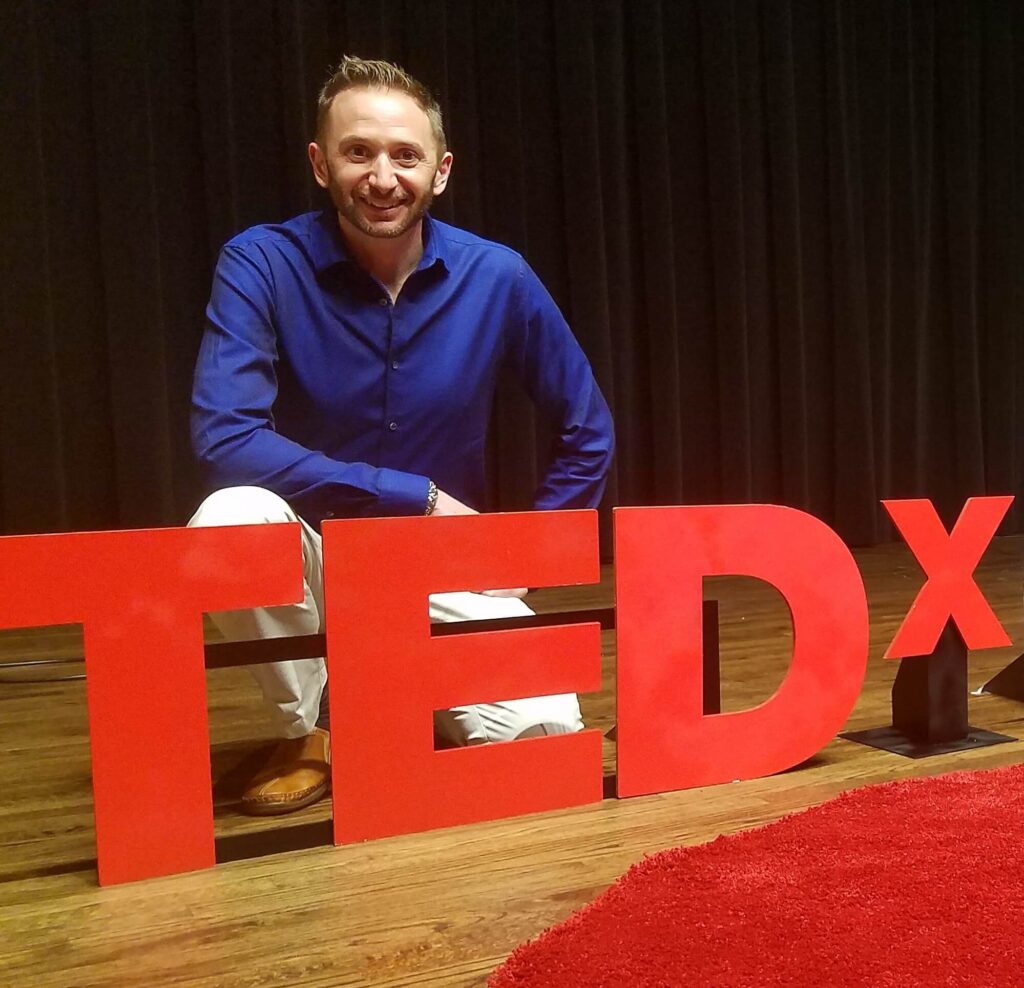
I’ve been a professional mountain guide for 27 years, including leading mountaineering expeditions in the Himalaya. I’m Ivy League educated, a Professor, a TEDx speaker, and a member of the Forbes Coaches Council. I’m also a dad.
And for years I was the man this page describes.
I built my identity on the mountain version of me because he was the only version I fully trusted. It took me a long time to see what I was actually doing out there. I wasn’t going to the mountains for fun. I was going to remember who I was. And then losing that man on the drive home, every single time.
The work I do now, with high-performing men in tech, finance, engineering, and healthcare, is the work I had to do myself: closing the gap between the man on the trail and the man at the desk. Not by burning your life down. By finally bringing the mountain self home and teaching him to stay.
On this expedition, the mountain logistics run through the best operation on Kilimanjaro, a team I chose after evaluating every serious operator on the mountain, with certified guides, daily health checks, oxygen carried on every climb, and food that men still talk about a year later. I lead the expedition and the work inside it. They hold the mountain. Between us, you’re carried by people who have spent their whole lives doing exactly this.
“I’m celebrating a bunch of wins. I started biking to work a few weeks ago. It had been a few years since I had a regular biking routine, and I was always making excuses. One of the main challenges I shared with Chris was being totally burnt out after work and so tired I would just go to sleep. Now I’ve got energy to do things at home I enjoy (or also chores and yard work). I also went on three dates, which were great (first time I have been on a date in years). I felt relaxed and myself. In the past, I feel like I would date or meet people to just validate my ego. But this time I was authentic and felt a spark.”
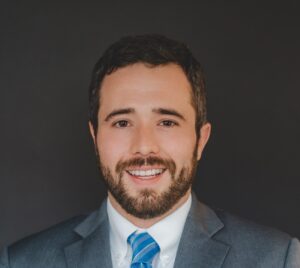
“Even though I knew I was blessed with a great job I still didn’t feel successful. For whatever reason I was telling myself I wasn’t good enough. I was carrying a whole lot of weight. Negative thoughts and self-talk. Allowing myself to get caught up in other people’s opinions of me. Now, using the Empowered Identity Method, my kids, my marriage, my job, even what I do in my free time- everything has improved.”
The trip is several months away, and that’s not an accident. A summit like this deserves months of real preparation, which is why applications close in February and the team is capped at ten. The runway is part of the design.
Here’s the honest math on waiting, though. If this page described you, it described you last year too. The loop doesn’t resolve on its own. It just runs another lap: another season, another trip that fades, another year of your kids getting the managed version of you instead of the mountain one. A year from now you’ll either be thirty days from this summit, or reading a page like this one again.
Dates: June 5 to 14 2027. Ten days in total, eight on the mountain.
Team: Ten men, max.
Route: Lemosho, 8 days, with Kosovo high camp at 16,010 ft. The most beautiful line on the mountain and the itinerary behind a 95 percent summit success rate.
Investment: $8,950
Applications close: Februrary or when the ten spots are taken.
Securing your seat: A $2,000 deposit locks your place after acceptance. The balance splits into two payments before departure.
Included
Not Included
No. Kilimanjaro is a trekking peak: no ropes, no technical skills. You need real fitness, stubbornness, and eight days of honest effort at altitude. You’ll have a full training plan and months of runway.
It’s the reason we take eight days instead of six and sleep high at Kosovo Camp. This itinerary exists to solve the altitude problem, and our 95% success rate shows it. Health checks every morning and night, oxygen carried on the climb in case of emergency.
Can you carry a backpack up 3k vertical and do it again the day after? That’s what this adventure takes. It’s ok if you’re not ready yet, you’ve got months to train. Support during that process is built into the trip. If you’re not feeling confident right now that’s ok, fill out the application and let’s talk to see if we’re a fit.
Because you’re comparing it to the wrong thing.
A standard guided trip promises to feed you, keep you safe, and point you uphill. What happens in your head on summit night, the thing that actually decides whether you stand on top, is your problem.
This trip is built around exactly that. It starts the day you enroll: a private session with me that week, my complete Summit Mindset course that night, monthly team calls through your training, a private readiness session before you fly, a mindset coach beside you for all eight days, and a structured 30-day re-entry protocol after you land.
The mountain is eight days. The coaching runs seven months.
That’s what you’re buying: a meaningfully better shot at the summit, the richest version of the experience itself, and, unlike every other trip you’ve taken, a way to bring what you find up there home. Compare it to a guided climb and it’s more expensive.
Compare it to what it actually is, and it’s underpriced.
I read every application personally. If it looks like a fit, we get on a 30-minute call, a real conversation, not a pitch. Then we both decide. Ten seats. We’ll both know.
Absolutely. Participants are invited to join an optional two-day game drive at the “8th wonder of the world” Ngorongoro Crater conservation area to experience the big five.
Toughness gets you up the mountain. It’s also why so many tough men grind through the biggest day of their lives wishing it would end. Mental toughness, the way it’s usually sold, means gritting your teeth and enduring. This is close to the opposite. We’re not training you to suffer harder. We’re training you to navigate the suffering better, so you’re not fighting yourself and the mountain at once, and you have enough of you left over to actually be there for it. I’ve watched tough men endure Kilimanjaro. The prepared ones experience it.
Ten seatS
Applications close February
Copyright © Ascent Coaching US 2026